Cinema Business Growth
How Cinema Halls Can Increase Food & Beverage Revenue: 12 Practical Strategies
From smart menus and faster service to seat-side convenience and unforgettable food experiences.
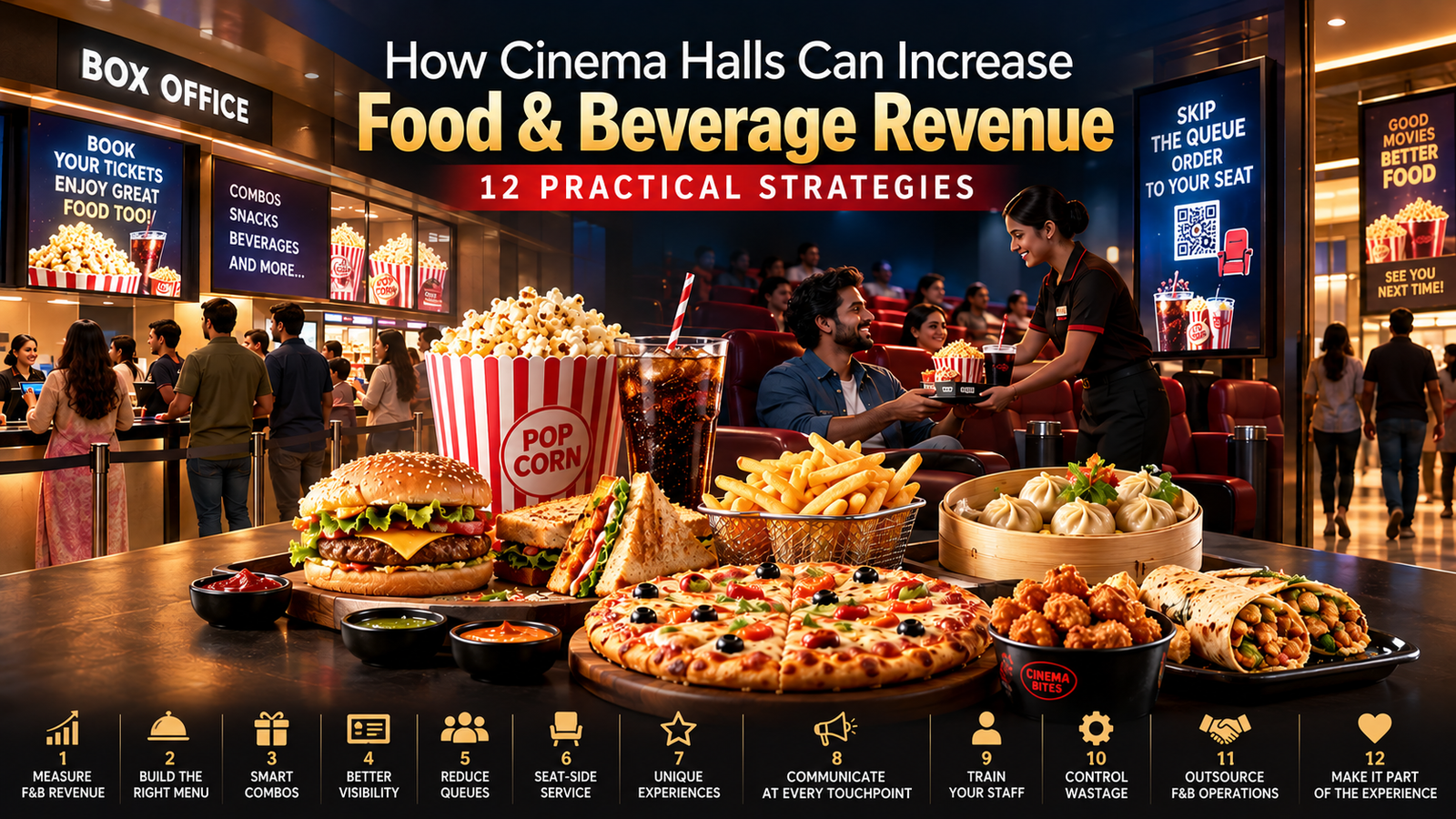
For a cinema owner, selling tickets is only one part of running a profitable entertainment business. What happens before a film, during the interval and even at the exit can contribute to revenue and customer satisfaction.
Food and beverage (F&B) sales offer an opportunity to earn more from existing visitors. Yet limited menus, queues, weak communication and poorly managed costs can prevent cinemas from reaching their potential.
More importantly, food should be treated as part of the moviegoing experience—not just another transaction. From ticket purchase to final exit, every moment is an opportunity to enhance that experience.
1. Measure F&B Revenue Per Admission
Before changing the menu or introducing offers, establish how the F&B business currently performs. One useful measure is F&B revenue per admission (RPA): total F&B revenue divided by total cinema admissions.
For example, 5,000 admissions and ₹2,00,000 in F&B sales produce an RPA of ₹40. Track this alongside the percentage of visitors buying food, average transaction value, item-wise margins and wastage. Revenue growth alone does not establish profitability.
2. Build a Menu Around Your Audience
A neighbourhood single-screen cinema and a premium mall multiplex may serve very different tastes and budgets. Develop a menu around local demand, practical preparation, service speed and price positioning.
Alongside popcorn, nachos and beverages, consider suitable options such as burgers, sandwiches, fries, momos, frankies, pizza slices, regional snacks and desserts. Test items rather than assuming a larger menu will produce higher sales.
3. Make Combo Offers More Relevant
Thoughtful combinations can help customers choose quickly and encourage multiple-item purchases. Consider solo snack-and-drink combos, couple sharing options, family packs and smaller kids’ portions.
Make the benefit easy to understand. Compare each combo’s selling price against ingredients, packaging, labour and other costs: a bigger bill is valuable only when the economics also work.
4. Improve Counter Visibility and Product Presentation
The counter should create appetite, not merely process payments. Use clear digital menus, appealing food photography, visible prices, illuminated product displays and attractive packaging where appropriate.
Put popular items and straightforward combinations where customers can notice them quickly. A customer with only minutes before a show should not need to decipher a complicated menu.
5. Reduce Queues During Peak Hours and Intervals
The interval is a short, high-demand selling window. Long lines, slow billing and complicated preparation can turn willing buyers away.
Consider express pickup for selected items, practical pre-preparation under food-safety controls, clear collection points and staffing aligned with show schedules. Faster service improves convenience and can increase the number of orders fulfilled.
6. Bring Convenience to the Seat: Seat-Side F&B Service
Imagine a moviegoer ordering a snack without leaving their seat. Where feasible, cinemas can explore seat-number-based QR ordering, pre-show seat delivery or controlled interval service.
Seat-side service requires disciplined operations: safe aisle access, accurate order fulfilment, suitable staffing and minimal disruption to the screening. Make ordering effortless, not intrusive.
7. Introduce Something Audiences Have Never Experienced Before
A signature snack, locally inspired speciality, unexpected flavour, inventive presentation or limited-edition menu can make the cinema experience memorable.
The idea is not novelty for its own sake. Pilot unique products, test audience response and check preparation speed, food safety and margins. A distinctive experience can create conversation and encourage repeat visits. Don’t just sell another snack; create something audiences remember.
8. Communicate at Every Touchpoint: From Box Office to Exit
F&B promotion should not begin only when customers arrive at the concession counter. Build an appealing, consistent communication journey across the visit.
Box office: introduce relevant combos while customers buy tickets. Lobby: use food photography, digital screens and product displays. Auditorium entry: highlight quick pre-show purchases. Pre-show: where permitted, introduce ordering options. Interval: promote express service and pickup. Exit: invite feedback and introduce a relevant future offer.
Ticket confirmations, websites and consent-based digital communication can support the same message. Each touchpoint should feel timely and helpful rather than repetitive or intrusive.
9. Train Staff to Upsell Naturally
Helpful staff can suggest relevant additions: “Would you like to make that a combo?”, “We have a sharing portion available,” or “Would you like to try our signature snack?”
Train teams in product knowledge, courteous communication, hygiene, order accuracy and service speed. Good upselling improves the purchase experience instead of pressuring customers.
10. Control Wastage and Protect Profit Margins
Review ingredient use, portion sizes, expiry dates, stock rotation, unsold prepared food, staffing and weekday-versus-weekend demand.
An item that sells frequently is not necessarily the most profitable. Use product-wise margins and wastage trends to adjust purchasing, preparation and the menu.
11. Evaluate Outsourced F&B Operations
Cinema owners may prefer to focus on exhibition rather than personally manage procurement, kitchen teams, inventory, hygiene and concession operations. For suitable properties, a specialised F&B partner can be an option.
Models may involve rental, revenue sharing or other agreed commercial arrangements. Evaluate food safety, accountability, service quality, transparent reporting and customer experience before signing.
Cafe Magic operates in the cinema F&B space and explores food-counter operating arrangements for suitable venues. Learn more about Cafe Magic’s F&B operations.
12. Treat F&B as Part of the Complete Cinema Experience
For many audiences, shared snacks and drinks are part of going to the movies. Consistent food quality, relevant choice, convenient service and pleasant interactions can help distinguish a cinema.
Collect feedback, trial seasonal items and review performance regularly. The aim is sustainable F&B profitability alongside a moviegoing experience people want to repeat.
Conclusion: Every Moment Is an Opportunity
Better F&B results do not always require a major kitchen investment. Relevant combos, clearer menus, faster interval service and disciplined inventory can make a difference. Other opportunities lie in seat-side convenience, signature products and appealing communication throughout the cinema visit.
The key shift is to manage food sales as a distinct business opportunity, with attention to both customer experience and sustainable margins.
For a related perspective, read 12 practical ways to increase cinema hall footfall and how independent cinemas can compete with multiplex chains.
Frequently Asked Questions
What is F&B revenue per admission?
It is total food and beverage revenue divided by total cinema admissions for the same period. It helps track spending alongside footfall.
Can seat-side ordering work in a cinema?
It may work where the layout, technology and staffing support safe, unobtrusive service. Pilot it before rolling out widely.
How can a small cinema increase concession sales?
Start with a locally relevant menu, clear combos, visible communication, efficient interval service and tracking of costs and wastage.
Should a cinema outsource its F&B counter?
It depends on operating capacity, commercial terms, food safety, customer experience and the suitability of an experienced partner.
Looking to Grow Your Cinema Business?
At The Magic Advertising, we support cinema businesses with branding, marketing, creative communication and audience engagement. Explore our cinema marketing services or Cafe Magic for F&B operating arrangements.
Discuss Your Cinema’s Requirements →What Is Your Biggest F&B Challenge?
Is it product innovation, seat-side convenience, customer communication or operational efficiency? We welcome perspectives and business enquiries from cinema owners and operators.
Share your thoughts with our team →These are general business ideas, not guaranteed revenue outcomes. Assess local demand, food safety, accessibility and financial feasibility before implementing them.